 Image 1 of 2
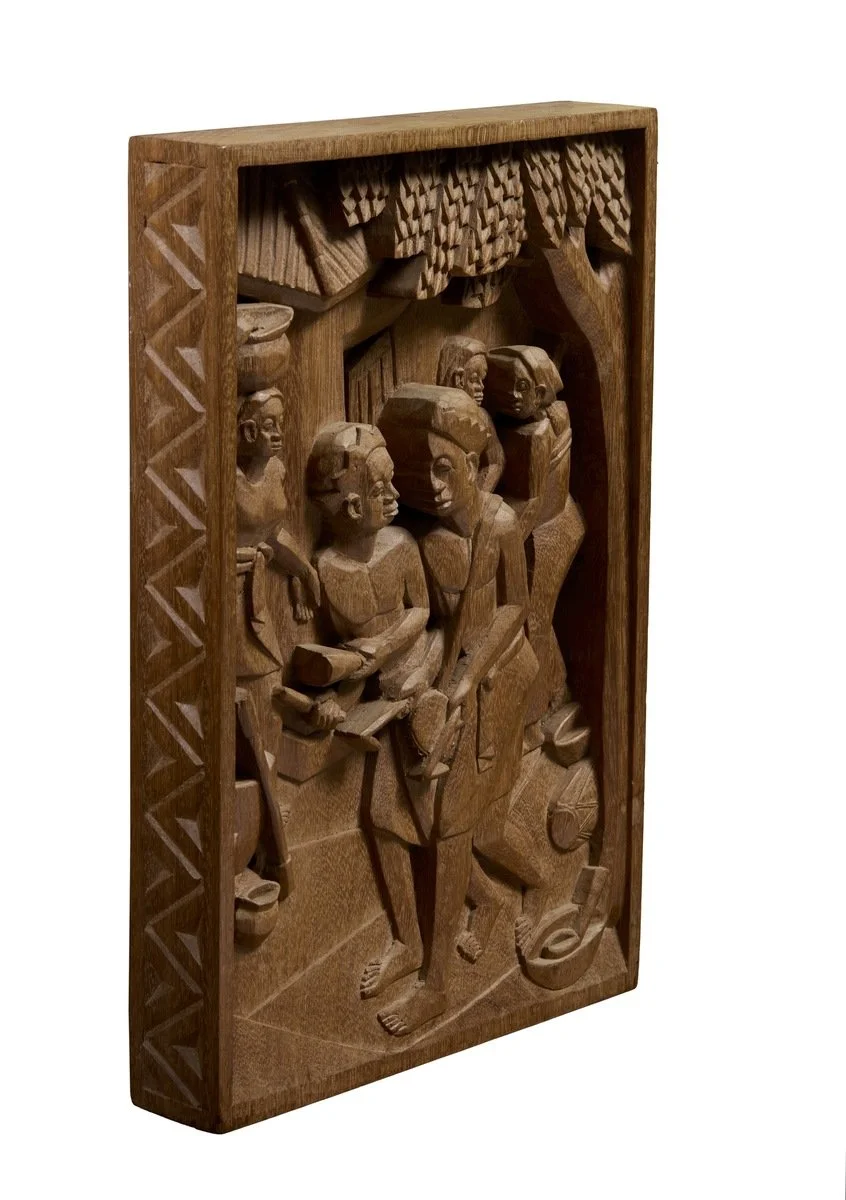 Image 2 of 2
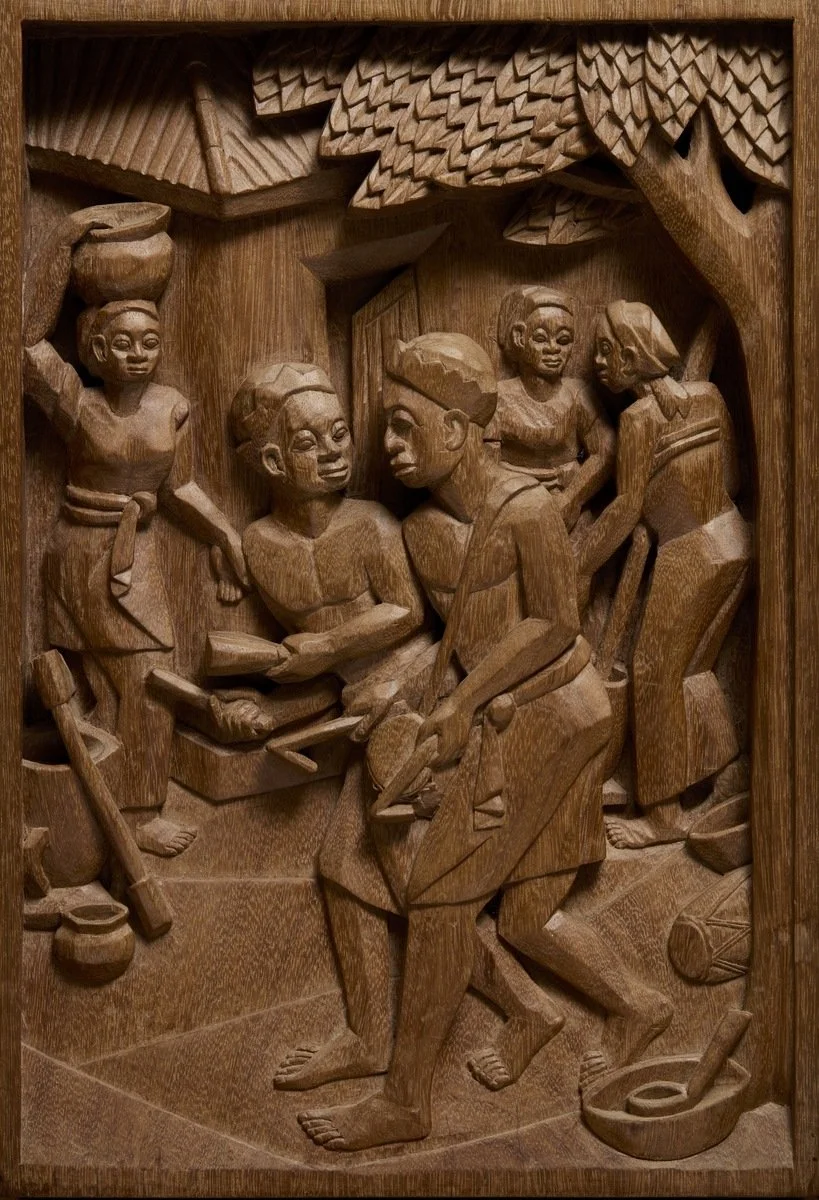
Kofi Antubam - Akan Musicians, circa 1960
56.3 × 38.4 × 7.4 cm
Provenance
Private Collection, United States
When the Gold Coast became Ghana in 1957, the first colony in sub-Saharan Africa to win its independence, it fell to one artist above all to give the new nation its visible form. Kofi Antubam—painter, carver, teacher, and writer—designed the chair on which its head of state sat, the mace carried before its parliament, and the murals and reliefs that adorned its public buildings. A founding father of modern Ghanaian art and one of the foremost figures of West African modernism, he drew Akan tradition and a European academic training together into a language that was unmistakably his own, and unmistakably Ghanaian.
Akan Musicians is a superb example of the carved relief panels in which that language found its most intimate expression. The composition is closely related to one of the great public commissions of Antubam’s career: the monumental murals painted for the Ambassador Hotel in Accra in 1956–57, and lost when the building was destroyed in 2000. Commissioned on the eve of independence, the murals offered a radiant vision of national unity, with landscapes of northern and southern Ghana, courtly processions, and scenes of village life. In the right-hand mural, horn blowers and linguists flanked a king, women pounded fufu, children played, men bent over a game of oware in the shade of a tree, and musicians filled the air with sound. Akan Musicians distils that world into a single, concentrated scene, and preserves in wood something of what was lost in paint.
In Akan society, music is far more than entertainment; it is a civic and spiritual language. Instruments such as the donno, or talking drum, and the dawuro, or gong-gong, sound out oral histories, warn of danger, praise chiefs, and set the rhythm of royal ceremony, sacred ritual, and community festival. At the centre of the panel two musicians walk side by side, turned towards one another in the easy exchange of men who have played together many times. One strides ahead, his cloth draped over one shoulder, beating the donno at his hip; his companion, bare-chested and smiling, keeps time on the dawuro. Both wear the same serrated cap. Around them the life of the compound goes on undisturbed. At the left a woman steadies a water pot on her head; at the right two others bend to their pounding beneath a spreading tree; a mortar and pestle, cooking pots, and a second drum lie where they were last set down. Music here is no performance set apart from the day, but part of its very fabric.
The carving is of the highest order. Antubam works in deep relief, building the scene in distinct planes from the hut and its half-open door at the back to the striding drummer, who stands almost free of the ground. The thatch is cut in crisp parallel ridges, and the canopy of the tree is rendered as a cascade of overlapping leaves, each one individually faceted and deeply undercut so that it catches the light. Faces and limbs are smoothly modelled against the tooled texture of the earth beneath them. The whole is contained within an integral frame cut from the same block, plain on its face but carved along its outer edges with a continuous zigzag band, a detail that shows the panel was conceived as a free-standing object, to be seen on an easel and not set into a wall.
The relief offered Antubam a medium uniquely his own. At a time when European commentators readily granted African artists a gift for carving while doubting their capacity for pictorial composition, he answered both at once, bringing to a block of wood the spatial recession, overlapping figures, and narrative richness of his painted murals. He returned to his favourite subjects across many media, producing variations in watercolour, ink, oil, and carved wood. The American photographer Willis Bell, who settled in Ghana in 1958, documented Antubam’s studio extensively, and his photographs record several of these relief panels, among them Welcome Papa, The Oware Game, and a variant of the present composition.
Antubam’s reliefs were widely exhibited during his lifetime and in the years immediately following his death. They were included in his 1961 Berlin show and in Commonwealth Art Today, the inaugural exhibition of the Commonwealth Institute in London, in 1962–63, and were shown posthumously at the First World Festival of Negro Arts in Dakar in 1966. Between 1961 and 1963, his carved panels toured the United States under the auspices of the American Society of African Culture (AMSAC), and it is probable that the present work was acquired through one of these American exhibitions.
AMSAC was an organisation of African-American scholars, artists, and writers dedicated to cultural exchange between Africa and its diaspora at the height of the Cold War. Antubam himself travelled to the United States in the early 1960s as a participant in the State Department’s Foreign Leader Programme, visiting Washington, D.C., Baltimore, Atlanta, Austin, Dallas, Los Angeles, San Francisco, and New York. A remarkable record of the AMSAC exhibitions survives. Nearly seven minutes of unedited black-and-white film in the US National Archives, titled Ghana Artist and Art Show, show guests at a reception, glasses in hand, gathered around Antubam’s carved reliefs displayed on easels, with the artist himself among them. Further footage, from the opening of AMSAC’s Lagos office in 1961, shows Antubam standing beside Ben Enwonwu: two of the leading artists of twentieth-century Africa, captured together on film.
Antubam was educated at Achimota College under the Russian-born sculptor Herbert Vladimir Meyerowitz, and it was there that he first painted scenes of village life and court ceremony on the school’s walls. After teaching in government schools in Kumasi from January 1947 to September 1948, he was awarded a Colonial Secretary’s Scholarship to study for the art teacher’s certificate at Goldsmiths College, London. He exhibited at every opportunity. A solo exhibition at the Berkeley Gallery in June 1949, from which three works entered the UK Government Art Collection, was followed by shows at the Colonial Office at Marble Arch and at Black Hall in Oxford the same year, and in 1950 at Grosvenor House in London, the Galleria Cit in Rome, La Galerie des Palmes in Paris, and the Kunsthalle Düsseldorf.
He returned to the Gold Coast to teach art at Achimota, where he remained for the rest of his life and trained a generation of Ghanaian artists. His ambitions were never provincial. In 1954, he called on Gold Coast artists “to lift their art from the low level of provincialism to the higher and brighter plane of world standard”. A world standard did not mean following Western fashion. Antubam firmly resisted the European assumption that African art must be defined by abstraction or formal distortion, writing in Ghana’s Heritage of Culture (1963) that what the Ghanaian expresses in art today “needs not necessarily continue to be featured by disproportions and distortions, which undoubtedly are the greatest qualities of the sort of art expected of him by the world outside Africa”. In their place he embraced Akan ideals of human beauty—the careful articulation of the body, the elegant fall of cloth, expressive gesture—and gave his figures a serene, idealised naturalism. Modern Ghanaian art, he wrote, should be “neither Eastern nor Western and yet a growth in the presence of both with its roots deeply entrenched in the soil of the indigenous past of Africa”.
Following independence in 1957, Kwame Nkrumah appointed Antubam Ghana’s official state artist. He designed and carved the Ghana State Chair, in sɛsɛ wood embellished with gold leaf and Adinkra motifs, together with the Presidential Footstool, the National Sword of State, and the Parliamentary Mace. He made carved panels and reliefs for the old Parliament Building and the Central Library in Accra and for the United Nations building in Geneva, painted murals for the Cocoa Farmers’ Co-operative and the Ambassador Hotel, carved reliefs for the ships of the Black Star Line, and created a monumental mosaic for the Accra Community Centre. He died suddenly of a stroke on 4 April 1964, in his early forties, with his career still rising.
Akan Musicians belongs to the most confident moment of Antubam’s career and of Ghana’s. Carved in the years when he was shaping the visual identity of a new state, it brings the ambition of his public commissions to the scale of a single panel, and joins the ancestral life of the Akan to the assured, modern hand of an artist at the height of his powers. Rare, finely carved, and bound up with the first presentation of Ghanaian modernism to an American public, it is a work of real distinction by one of the defining artists of African independence.