 Image 1 of 1
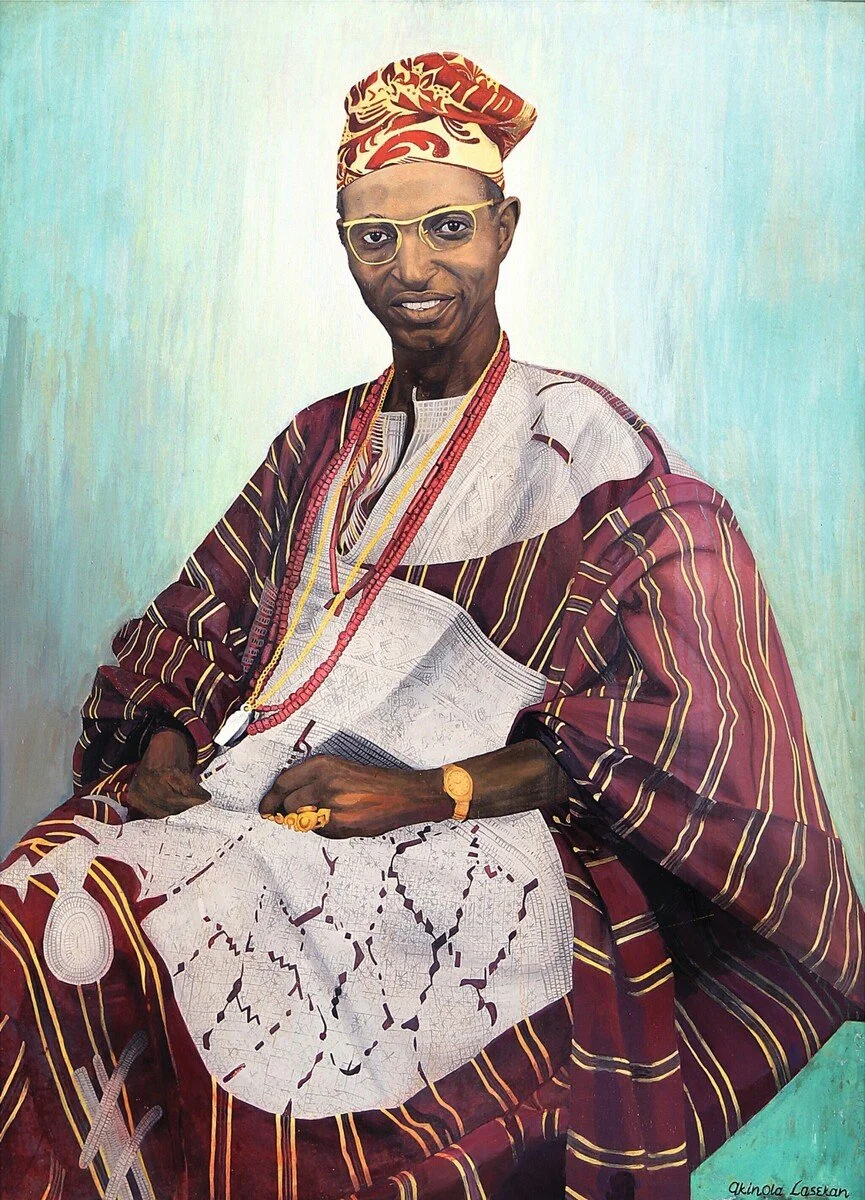
Akinola Lasekan - Portrait of Chief J.D. Akeredolu, 1957
147 × 106 cm
Provenance
Private Collection, Lagos
Sale, Sotheby’s London, Modern and Contemporary African Art, 31 March 2020, lot 16
Private Collection
Exhibited
Lagos, Victoria Island, Trade Fair, Art Pavilion, The Nigeria Exhibition, 1–22 October 1960 (organised by the Nigerian Council for the Advancement of Art and Culture)
London, Tate Modern, Nigerian Modernism, 8 October 2025 – 10 May 2026, illustrated in the catalogue, p. 87
Literature
C. Okeke-Agulu, Postcolonial Modernism: Art and Decolonization in Twentieth-Century Nigeria, Durham and London, 2015, p. 145, illustrated p. 119
Catalogue note
This portrait commemorates the friendship between two of the foremost Nigerian artists of the pre-independence generation: the painter Chief Akinola Lasekan (1916–1972) and his sitter, Chief Justus D. Akeredolu (1915–1984), a master carver renowned for his work in thorn. Both men were born in Owo, in present-day Ondo State. In 1940 they established a joint studio in Lagos, and five years later they travelled together to London to exhibit their work and further their studies. In the years leading up to independence each refined a distinct medium, Lasekan in portrait painting and Akeredolu in thorn carving, in service of a shared ambition: to represent the Yoruba people as proud, cultivated and self-determining, in direct rebuttal of the stereotypes fashioned by their colonisers.
Their careers ran in close parallel. Both were collected and exhibited by the Harmon Foundation in the United States in 1958–59. Both showed at The Nigeria Exhibition, staged at the Trade Fair on Victoria Island, Lagos, in October 1960 to celebrate independence, where the present work was also included. Painted three years earlier, in 1957, it ranks among Lasekan’s best-known works and is a superlative example of his portraiture of the 1950s.
Akeredolu sits turned three-quarters towards the viewer, meeting our gaze with an easy, unguarded smile. It is the expression of a friend rather than a patron. Lasekan sets him against a loosely brushed turquoise ground, dragged in long vertical strokes. That freedom throws into sharp relief the meticulous attention he lavishes on his sitter’s dress. Akeredolu wears a voluminous agbada of aso oke. Its deep crimson, shot through with fine gold stripes, suggests alaari, the prestige silk cloth of Yoruba ceremonial dress. Beneath it is a white buba. The broad embroidered panel of the agbada falls across his chest and lap, rendered almost stitch by stitch in greys and whites, its maroon motifs scattered across the cloth like script. A fila of red and cream patterned cloth is worn at a jaunty angle. Several strands of coral beads, the emblem of chiefly rank, are layered with a fine gold chain. Equally telling are the details Lasekan chose to keep: the pale-framed spectacles, the gold wristwatch and the heavy ring. Akeredolu is shown entirely at ease as both a titled chief and a modern professional.
Lasekan’s command of cloth was hard-won. He was born Samuel Akinola Oladetimi at Ipele, near Owo, the son of Chief Oyekanmi Oladetimi Lasekan and Madam Lydia Ayobolu. He began his professional life not as a painter but as a textile designer with the Compagnie Française de l’Afrique Occidentale, an apprenticeship whose imprint is unmistakable in the virtuosic handling of pattern seen here. He went on to illustrate books for the CMS Bookshop and Thomas Nelson Ltd., and in 1941, the year he adopted the name Akinola Lasekan, began teaching art. He pursued formal training by correspondence, studying commercial art with the Hammersmith School of Art in London and earning further credentials from Normal House and the Washington School of Art. In 1962 he was elected a Fellow of the Royal Society of Arts.
A student of Aina Onabolu, the father of Nigerian modern art, Lasekan began under the influence of his teacher’s naturalism and preference for portraiture. He never abandoned the portrait, as the present work attests, but he developed a style increasingly his own, steeped in Yoruba subject matter and legend and prized for its precision of detail and assured, elegant colour. Alongside Ben Enwonwu he is now recognised as one of the pioneers of Nigerian Modernism. Through his teaching, his instructional texts and the correspondence art school he founded, he was also one of the movement’s most influential educators, a legacy he extended in later life through posts at the University of Nigeria, Nsukka, and at Ife (now Obafemi Awolowo University).
His engagement extended well beyond the studio. An outspoken critic of colonial rule and of the conservative establishment, Lasekan aligned himself with the nationalist movement and became Nigeria’s first political cartoonist. The same conviction, the determination to picture Yoruba subjects with dignity and authority, animates this portrait of his friend and fellow artist, painted at the height of his powers on the eve of Nigerian independence.