 Image 1 of 1
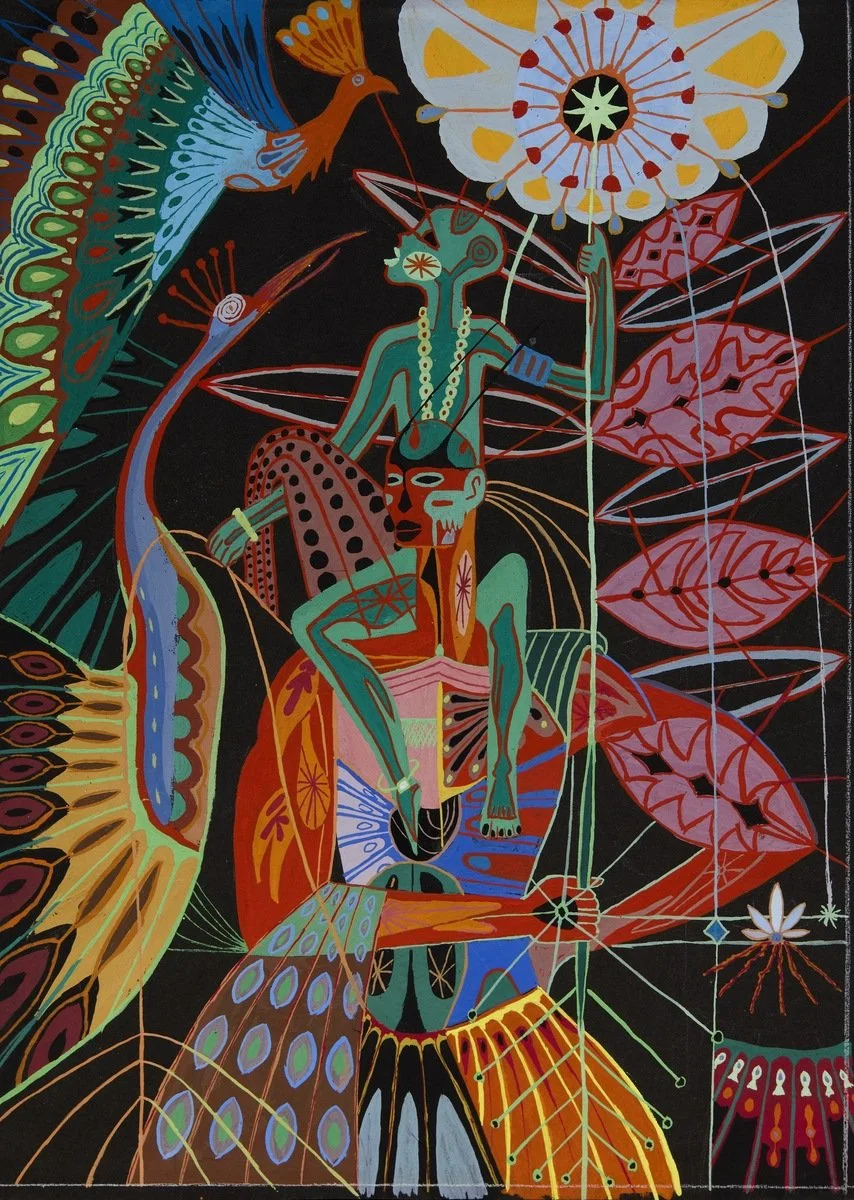
Papa Ibra Tall - Wonders of the Bush (maquette), circa 1964-1965
28 × 20 cm
Provenance
Private Collection, Belgium
Literature
The UNESCO Courier, November 1965, p. 32 (UNICEF version illustrated in black and white)
The Rotarian, vol. 109, no. 3, September 1966, p. 10 (UNICEF version illustrated on the front cover)
V. M. Polevoy (ed.), Popular Art Encyclopedia (Популярная художественная энциклопедия) (Moscow: Soviet Encyclopedia Publishing House, 1986), vol. 2, p. 308 (illustrated in black and white)
Topic (United States Information Agency, Press and Publications Service), no. 62, 1972, p. 19
In 1965, the same year UNICEF was awarded the Nobel Peace Prize for promoting international brotherhood and aiding vulnerable children, its greeting cards carried a design by a young Senegalese painter into homes across the world. The present work is one of three known colourways presented by Papa Ibra Tall as gouache maquettes for a tapestry of the same title; it was another of the three that UNICEF selected for its greeting card programme, and that was reproduced in magazines and newspapers across the globe.
The composition is also known by its French title, Féerie de la brousse, and its Wolof title, Nijaay. In Wolof society, nijaay denotes the maternal uncle, a figure who traditionally holds a central role in guidance, protection, and the transmission of social heritage. It is this bond that Tall places at the heart of the picture, as the UNESCO Courier recognised in November 1965: “In this painting by the Senegalese artist, Papa Ibra Tall, an uncle supports his young nephew high on his shoulders as he introduces him to the plants, the birds, and other wild life of the bush.”
Out of a ground of velvet black, the composition rises in a single, soaring movement. The uncle stands at its centre, monumental and still, his red, mask-like face set off by a pale beard, one arm sweeping across his body to grasp the stem of an immense flower. Astride his shoulders sits the child, seen in profile and strung with long necklaces of beads, his face lifted in wonder towards a crested bird that hovers above. With one hand the boy holds the flower’s stem; with the other he reaches down towards a crane whose long neck curves up beside them. He becomes the point at which plant, bird, and man are joined, and the whole teeming world of the bush seems to turn around him.
Tall allows no distinction between figure and setting. The uncle’s skirt blazes with the eyes of peacock feathers, his torso is divided into jewelled panels of ornament, and the same fans, ovals, and radiating lines that form the birds and foliage also make up the two bodies. Fine pale lines cross the surface like threads, meeting in star-shaped nodes, one of which is the uncle’s hand closed around the stem. There is no horizon and no recession: every form sits on the surface, bounded by a sure, unbroken contour and filled with flat, matt colour of remarkable intensity. This is a design conceived for the loom, and it has all the richness of the medium it anticipates.
The three known colourways share the same drawing, yet each strikes an entirely different chord. The version reproduced by UNICEF is the darkest and warmest: the uncle is a saturated red, the child a muted slate green, and the leaves at the right a deep violet that sinks into the black ground. A second version is cooler and more sharply contrasted, with leaves of cobalt blue, a vivid green child, and a white flower with blue inner petals; its line is freer and its brushwork more openly visible. The present work is the most luminous of the three. Its leaves are a soft rose-pink veined with red, the great flower is pale grey and blue with petals centred in yellow, and the child is a clear turquoise against the red and orange of his uncle. Where the UNICEF version gathers the design into red and violet, here Tall opens his palette to its fullest, and the pink, yellow, and pale blue seem to glow against the dark.
The subject is also a declaration. Tall had moved in the circle of Aimé Césaire in Paris and was close to Senegal’s first president, the poet Léopold Sédar Senghor, and he set out to give Négritude a visual form of its own, rejecting imported European academic styles in favour of a language drawn from African mythologies and local folktales. Wonders of the Bush distils that conviction into a single, unforgettable image. Knowledge passes here from an elder to a child, out of doors and on the shoulders, and what is handed on is a way of seeing the land and its creatures. Man and nature are shown as one continuous fabric, made of the same ornament and bound by the same lines. In the early years of independence, with Senghor placing culture at the very centre of the new state, a picture of inheritance was also a picture of the nation.
Born in 1935 in Tivaouane, Senegal, Papa Ibra Tall began his formal training in Europe in 1955, studying at the École Spéciale d’Architecture and the Beaux-Arts de Paris. In the French capital he immersed himself in the Négritude movement and the rhythms of Black American jazz, while collaborating with the publisher Alioune Diop to illustrate the covers of Présence Africaine books. His circle widened rapidly: in 1959 he helped organise an exhibition of Black artists living in Europe for the 2nd Congress of Black Writers and Artists in Rome, and the following year, during a study trip to the United States, he met John Coltrane and Malcolm X. Returning to Senegal on its independence in 1960, he took up a foundational role at the head of the Section de Recherches en Arts Plastiques Nègres within the national art school, before travelling back to Europe in the early 1960s to undertake specialised training in pottery, in applied media at the École des Métiers d’Art, and in tapestry weaving in Vincennes.
This apprenticeship was the bedrock of Tall’s great ambition: to make tapestry a distinctively Senegalese art. His efforts began in earnest in 1964, when he added a tapestry studio to his section at the art school in Dakar. At the end of that inaugural year, he arranged for four of his earliest students—Mamadou Wade, Mar Fall, Doudou Diagne, and Alioune Badara Diakhaté—to train at the Manufacture des Gobelins in France. Following their training in 1964–65, these artists worked alongside Tall in the newly established national tapestry workshop, the Manufacture Nationale de Tapisseries (later the Manufacture sénégalaise des arts décoratifs, or MSAD) in Thiès, which opened in December 1966. Under the patronage of President Senghor, its tapestries hung in state buildings and travelled the world as diplomatic gifts, becoming the most visible and most admired achievements of Senegalese modernism. Tall served as its director from 1966 to 1974 and again from 1989 to 2010.
The maquette dates from circa 1964–1965, the very moment at which the organisation of Tendances et confrontations, the exhibition of contemporary art at the First World Festival of Negro Arts (FESMAN), was first entrusted to Tall in his capacity as head of the Section de Recherches en Arts Plastiques Nègres. He was the natural choice to act as President of the Commission for Contemporary Art: his work celebrated Pan-African themes and, for many, gave visual form to Senghor’s writings on Négritude. From 1965, however, the project was led to completion by Iba N’Diaye, and the handover carries a particular charge. The two men headed rival sections of the same school and stood for opposed visions of what a Senegalese artist should be. N’Diaye, in the Section Arts Plastiques, insisted on technical discipline, drawing from observation, and a knowledge of art history, and was wary of an art that set out to look African. Tall, joined from 1961 by Pierre Lods, held that his students’ strength lay in instinct and imagination, and kept European models at a distance. The disagreement hardened into a professional and ideological rift. The exact reason for the change of leadership remains open to discussion: one hypothesis is that Tall’s departure from Dakar to establish and direct the workshop in Thiès drew his energies elsewhere. Whatever its cause, the exhibition that was to present the art of Négritude to the world was completed by one of its sceptics, while Tall turned to the loom.
Tall’s influence, as artist and as institution-builder, extended far beyond Senegal’s borders. He represented his nation at the 8th São Paulo Art Biennial (Brazil, 1965), FESMAN (Dakar, 1966), and the 1st Pan-African Cultural Festival in Algiers (1969). Between 1974 and 1991, his works and tapestries toured in exhibitions of contemporary Senegalese art across Europe, Asia, and the Americas, alongside solo exhibitions in Canada, France, the Soviet Union, and Senegal, culminating in Dessins de Papa Ibra Tall, the last major retrospective of his lifetime, held in 1991 at the Galerie Nationale d’Art in Dakar. In 2013 his tapestries took their place at the 55th Venice Biennale. He died in Dakar in 2015.
The present maquette belongs to the very beginning of that history. When it was painted, the studio in Dakar had only just been founded, the first weavers were in training, and Thiès had yet to open its doors. Tall’s language is nonetheless already complete, in its line, its ornament, and its radiant colour. It was this image, in a design made to be woven, that carried his vision to an international public before a single tapestry had left the workshop. Rare, resplendent, and of real historical consequence, Wonders of the Bush stands at the threshold of one of the great projects of African modernism.