 Image 1 of 1
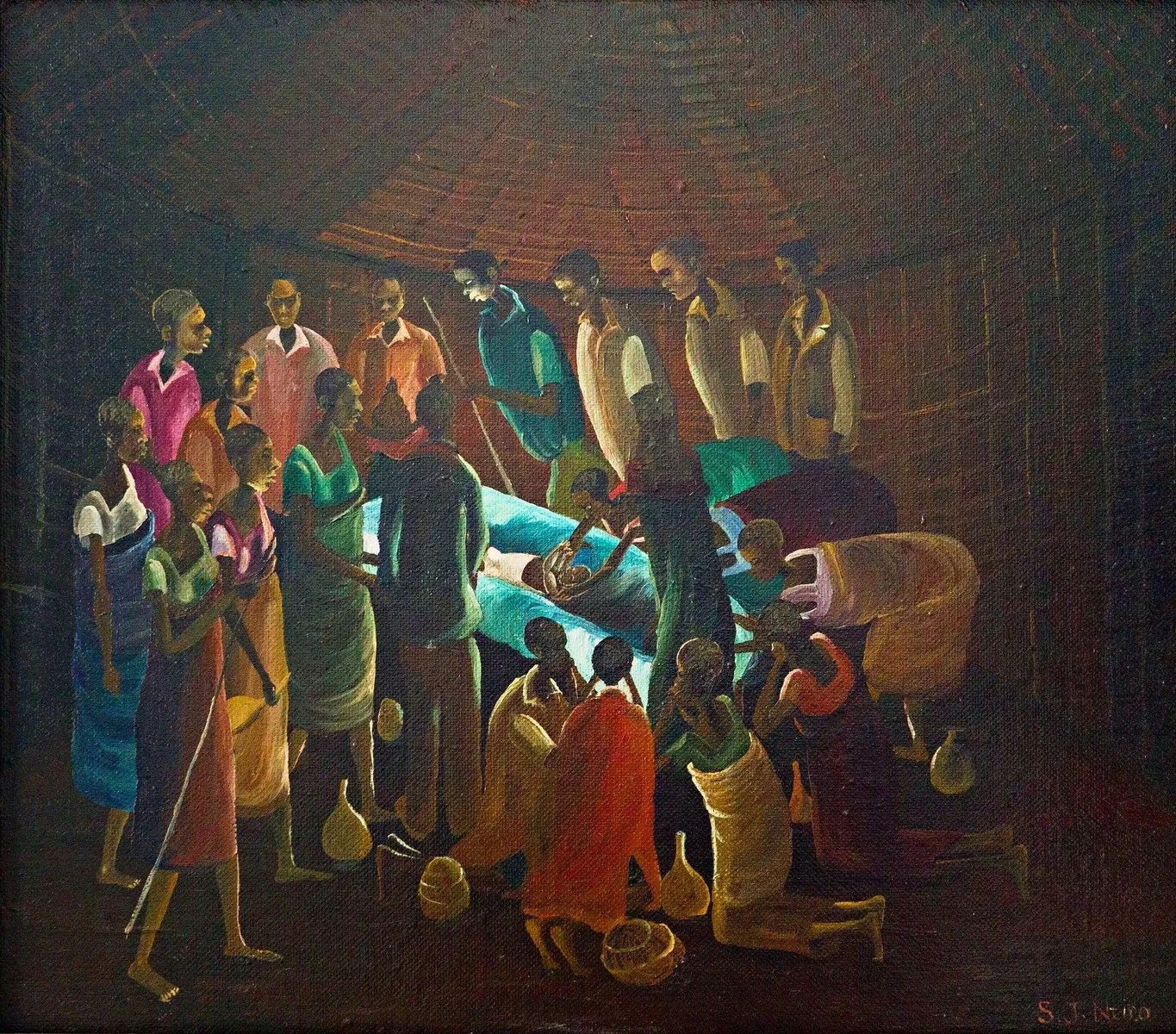
Sam Joseph Ntiro - A Gift of Nativity, circa 1960
53.3 × 61 cm
Provenance
Professor and Mrs Jerrold R. Zacharias, a gift from the artist, 22 October 1963
On 22 October 1963, Sam Ntiro inscribed a label on the back of this painting: “A gift of Nativity to Prof and Mrs J Zacharias”. The words make a quiet play on the title. The gift is at once the painting, given by one friend to another, and the Nativity itself, the gift at the heart of the Christian story. Given by the foremost pioneer of East African modernism while he was serving as Tanganyika’s High Commissioner in London, A Gift of Nativity distils the central preoccupation of Ntiro’s career: the retelling of Christian scripture as African experience, set among the people, houses, and customs of his own Chagga homeland on the slopes of Kilimanjaro.
Ntiro was born in the Kilimanjaro region of Tanganyika to Lutheran parents and educated at a Lutheran mission school, and biblical narrative stood at the centre of his visual imagination from childhood. That grounding deepened at Makerere, in Uganda, where he studied and later taught under Margaret Trowell, a devout Christian who encouraged her students towards a new religious art rooted in African forms and settings. For Ntiro this was a matter of conviction. “My conviction, as a Christian, is that if Christianity is to penetrate into our hearts, then Christ must be one of us,” he said.1 His Last Supper takes place in a round Chagga hut, where Christ and the disciples eat banana and meat from traditional Chagga bowls; his Entry into Jerusalem unfolds among the hills of Kilimanjaro. In 1959 he completed a great mural in five panels for the Anglican church at Kakindo in Uganda, ten feet high and thirty-two feet long. At its consecration, Bishop Leslie Brown declared that Jesus Christ was not a European, for he belongs to everyone.2 Later commissions included the Word and Sacrament triptych for Hothorpe Hall in England.
A Gift of Nativity sets the birth of Christ within the darkened interior of a Chagga house, its thatched roof rising in concentric rings overhead. Mary lies on a low bed beneath a cloth of glowing turquoise, the swaddled Child in her arms, while a woman bends tenderly over them. Around the bed the whole community has gathered, some two dozen figures in all. Elders leaning on their staffs, the shepherds of the story, stand at the left; men in collared shirts and jackets bow their heads at the back; women in wrapped cloths and bright dresses crowd forward; at the centre a single figure stands with his back to us, drawing the viewer into the circle. In the foreground, kneeling women set down their offerings – gourds and woven baskets – in place of the gold, frankincense, and myrrh of the Magi. This is no distant Bethlehem but a birth among neighbours, in the dress and the homes of Ntiro’s own time, and the Holy Family are received exactly as a newborn child would be welcomed in a Chagga village.
What lifts the painting far beyond a simple exercise in this idiom is its handling of light. As a student at the Slade School of Fine Art in the early 1950s, Ntiro travelled through Italy and France, and in April 1954 he wrote to his professor, William Coldstream, singling out two paintings that had held him: the Martyrdom of Saint Sebastian by Antonio and Piero del Pollaiuolo, and Georges de La Tour’s candlelit Saint Joseph the Carpenter.3 The debt to La Tour is unmistakable. In La Tour’s picture it is the young Christ who holds the candle, lighting the face of his father at work. Ntiro takes the idea a step further: here there is no candle and no fire at all. The light rises from the bed itself, from the Child, illuminating the faces bent over him in warm, concentrated pools while the darkness of the house presses close around. It is the same conceit that Correggio made famous in his Holy Night, and Ntiro uses it to theological purpose. In a lecture to the Royal Society of Arts in May 1963, he explained that the fire in his Last Supper was more than a source of light: it stood for the Christian fire that burns not outside but in the hearts of the converted.4 In A Gift of Nativity, that inner light has become the subject of the picture.
This formal sophistication sits uneasily with the reception Ntiro often met in his lifetime. The British press had taken note of him from his first exhibition at the Piccadilly Gallery in London in 1955, and when he showed there again in November 1964, the critic Eric Newton praised his “obstinate refusal to pick up painterly hints from Western civilisation”.5 The compliment, however well meant, cast Ntiro as an untutored, instinctive painter working outside the history of art. A Gift of Nativity argues otherwise. At first sight it may read as a simple devotional scene; on closer looking it reveals a painter fully conversant with the pictorial strategies of the Renaissance and the Baroque, deploying them not to imitate a European tradition but to make it African.
By the time of this gift, Ntiro had won remarkable recognition in the United States. In May 1960 the Merton D. Simpson Gallery in New York presented his Oil Paintings on Life in British East Africa, and that year the Museum of Modern Art acquired his Men Taking Banana Beer to Bride by Night (1956), making him the first modern African artist to enter an American museum collection. He was championed by the Harmon Foundation, the New York philanthropy that collected and promoted modern African and African diaspora artists in these years, and two of the oil cartoons for the Kakindo mural, The Crucifixion and The Conversion of Saint Paul, entered its collection. The Foundation’s interest was not without its politics. Its director, Mary Beattie Brady, described Ntiro and his wife as articulate, “forward looking people” from the “advancing countries” of Africa, and hoped that artists of his standing would help ensure that “democracy and the Christian approach to life will triumph”.6 In the climate of the Cold War, an African modernism that was Christian in subject and legible to Western institutions was a valuable ally, whether or not Ntiro shared the Foundation’s aims.
The painting’s recipients belonged to the same moment. Jerrold R. Zacharias, the Massachusetts Institute of Technology physicist who had led the Physical Science Study Committee from 1956 and transformed the teaching of science in American schools, turned his attention to Africa after a conference at Rehovot in 1960. In 1961 he organised the Endicott House conference that launched the African Education Program, and from 1962 its workshops met at Entebbe, in Uganda, bringing together African educators and international specialists. Ntiro, himself a teacher for much of his career and in 1963 the senior representative of a newly independent Tanganyika in London, moved in the same world of African education and international exchange. How the two men first met is not recorded, but the label on the reverse leaves no doubt of the warmth of the gift.
A Gift of Nativity is thus both an intimate token of friendship and a document of a remarkable chapter in the history of African modernism, when a painter-diplomat from Kilimanjaro carried his vision of an African Christ into the heart of transatlantic cultural life. It rewards sustained looking with a command of light and composition too often overlooked in the critical reception of an artist who insisted, above all, that Christ must be one of us.
1 Quoted in Oil Paintings on Life in British East Africa by Sam J. Ntiro, exh. cat. (New York: Merton D. Simpson Gallery, 1960).
2 Uganda Argus, 21 November 1959.
3 S. J. Ntiro to William Coldstream, April 1954, UCL Special Collections, University College London.
4 Sam Ntiro, “East African Art”, Journal of the Royal Society of Arts 111, no. 5082 (May 1963), pp. 465–82.
5 Eric Newton, “Sam Ntiro Exhibition”, Guardian, 18 November 1964.
6 Quoted in John C. Walter, “The Harmon Foundation and the Sponsorship of Contemporary African Artists, 1947–67”, Contours: A Journal of the African Diaspora 1, no. 2 (Fall 2003), pp. 199–218.