 Image 1 of 1
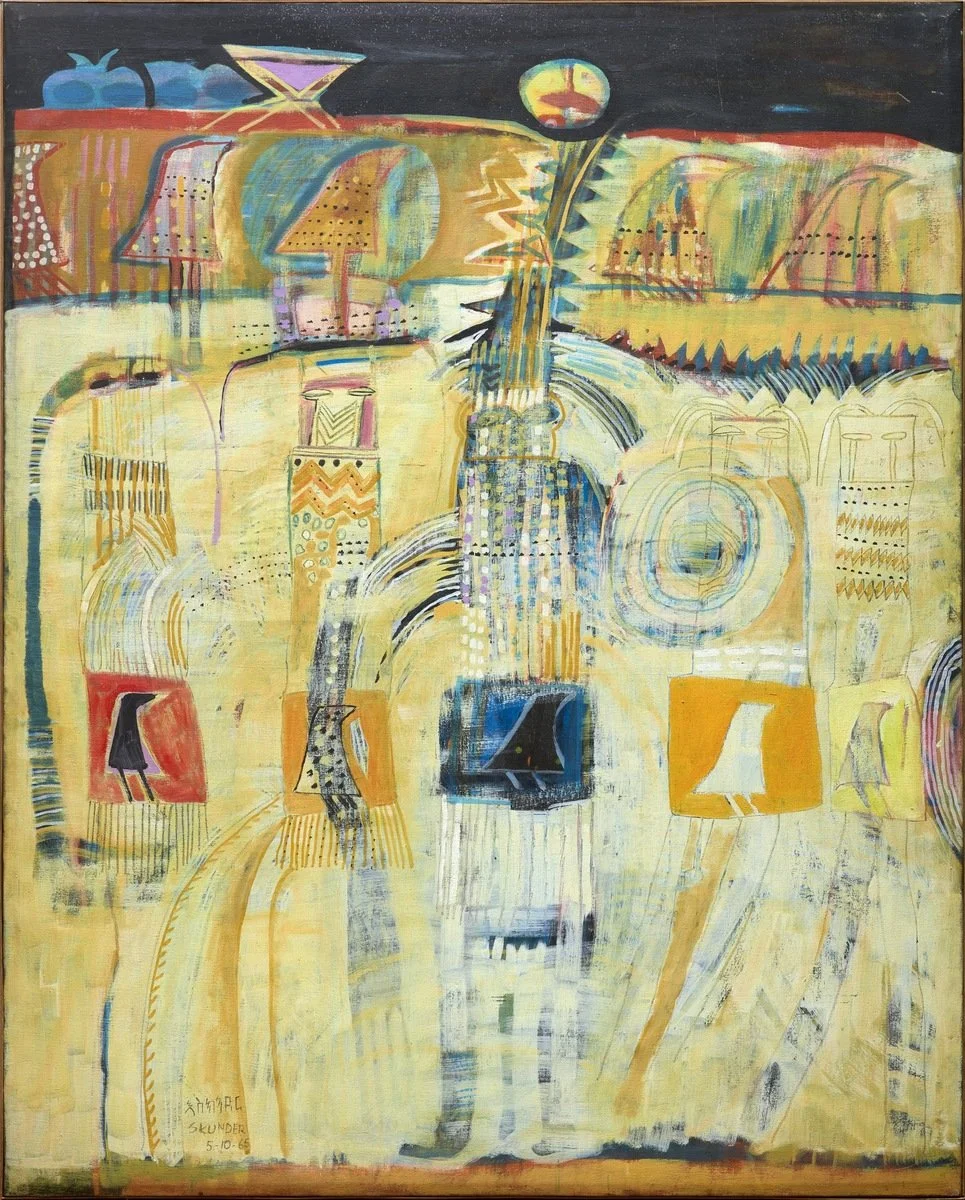
Alexander (Skunder) Boghossian - Untitled, 1965
162 × 130.5 cm
Provenance
Collection Jean-Pierre Vielfaure (1930-2015), acquired directly from the artist, Paris, 1960s
I grew up in the streets of Paris, I had no problem being black or yellow or green. I learned my craft.
– Skunder Boghossian1
Dated 5 October 1965, Composition was painted in the last autumn of Skunder Boghossian’s decade in Paris, three months before he boarded the plane for Addis Ababa and left the city for good. It is the culmination of the period widely regarded as the most important of his career, the years in which a young Ethiopian scholarship student became one of the most original voices of the international avant-garde. Across a luminous field of sand and gold, a procession of tall, masked figures advances beneath a black night sky, each bearing a bird upon its hip, while a frieze of hooded forms runs along the horizon and a radiant orb rises above them all. Painted on the monumental scale of his most ambitious canvases, the work never left Paris. It was acquired directly from the artist by his friend and fellow member of the Phases movement, the painter Jean-Pierre Vielfaure, and has remained in that collection ever since. It is a museum-quality work from the turning point of Skunder’s life.
Skunder arrived in Paris in 1957, aged twenty, having found the art schools of London too academic for his purposes. He enrolled at the École Nationale Supérieure des Beaux-Arts and the Académie de la Grande Chaumière, where he studied under Curt Goetz and met André Breton, whose informal Saturday seminars in a café near Saint-Germain he habitually attended. But his true education took place outside the classroom. “Paris was ablaze with black creativity,” recalled his friend the Ethiopian poet and critic Solomon Deressa. “Why, indeed, would a sane young African artist sit in a classroom when the real academy was wide open?”2 In the cafés Skunder listened to Cheikh Anta Diop, Aimé Césaire, Richard Wright, James Baldwin, and Chester Himes; in the jazz clubs he heard Bud Powell, Lester Young, and Sonny Rollins; and in 1959, still only twenty-one, he exhibited at the Second International Congress of Negro Writers and Artists in Rome, alongside Gerard Sekoto, Papa Ibra Tall, and Wilson Tiberio.
Paris also gave him Africa. For a year he visited the African galleries of the Musée de l’Homme daily, studying masks, figures, and reliquaries from across the continent, and the collector and historian Madeleine Rousseau taught him the Dogon cosmology of the vital force. Then came Paul Klee: “In his work I found everything – magic, poetry, humour, mysticism. His language of significant signs spoke to me, and I began to see the range of possibilities in a line and how much it could convey.”3 Wifredo Lam and Roberto Matta he had first encountered by chance. In London, Skunder had passed a small gallery and seen in the window a drawing that “actually gave me a bodily shock”. It was by Lam; inside hung paintings by Matta. “The effect of all this was confusion about my work,” he said, “but eventually that confusion became a suggestion.”4 Lam remained the artist he would name above all others: “If there was an artist that I would say that I was influenced by, it would be Wifredo Lam.”5 It was Sekoto and Tiberio, elders of the Black artistic community in Paris, who introduced the young painter to Lam himself at the Rome congress in 1959.6
From these sources Skunder forged what he called “Afro-Metaphysics”: a pictorial philosophy drawn from Dogon cosmogony, the spirit-haunted novels of Amos Tutuola, the healing scrolls and liturgical arts of Ethiopian Orthodoxy, and the biomorphic freedoms of Surrealism. Its first great expression was the Nourishers series, shown at the Mbari Gallery in Ibadan in July 1963 and in Munich, and then in January 1964 at the Galerie Lambert in Paris. The Paris critics were virtually unanimous in their praise. In 1963 the Musée d’Art Moderne de la Ville de Paris acquired a painting by him, its first purchase from an African artist.
His standing rose rapidly. He was invited to join Phases, the international avant-garde movement led by Édouard Jaguer, and exhibited with the group at the Galerie de l’Université in Paris and, in October 1964, at the Musée d’Ixelles in Brussels, where his work hung alongside that of Jean-Pierre Vielfaure. He then left Phases to work with Breton in the months leading towards L’Écart absolu, the eleventh and last of the great international Surrealist exhibitions. From November 1964 to January 1965 he showed at the Galerie Ranelagh in Paris, and in 1965 he was included in Alternative Attuali, where he was presented as the youngest of all the painters selected. That autumn he was the only Ethiopian painter at the IVe Biennale de Paris, which was open when the present work was signed. In New York, the same year, the Museum of Modern Art acquired Ju-Ju’s Wedding, making him the first Ethiopian artist in its collection.
Yet Skunder’s gaze had long since turned across the Atlantic. His first visit to the United States, in 1961 for a Harmon Foundation exhibition, introduced him to Merton Simpson, and through Simpson to Jacob Lawrence, Hale Woodruff, Charles White, and the artists of the Spiral group. “They were like big brothers,” he recalled. “They were my American mentors.”7 A solo exhibition with Simpson followed in 1962, and in 1963 he was included in the American Society of African Culture’s African Art Open House in New York. In the summer of 1964 he travelled to Tuskegee, Alabama, to marry Marilyn Pryce, an African-American student and civil rights activist he had met in Paris. Living in a Black community in the Deep South at the height of the Civil Rights Movement, he painted with extraordinary intensity: the Ju-Ju series, Ju-Ju’s Wedding, and Night Flight of Dread and Delight (North Carolina Museum of Art), in which a turbulent transatlantic flight becomes a meditation on the Middle Passage. That November, back in Paris, Malcolm X spoke at the offices of Présence Africaine.
Skunder himself credited Europe with forming him in the 1950s and America in the 1960s. Through the poets A. B. Spellman and Langston Hughes, the saxophonist Marion Brown, and the painter Kofi Bailey, he came to see what he called the neo-African spirit reborn in the eyes of Black America. His small studio in Montrouge became a meeting place for that world. “Black American, Latin American, African and other Third World artists, writers, and musicians met at Skunder’s Montrouge studio,” wrote the painter and critic Wendy Kindred. “There was always jazz.”8 As Deressa put it, “There are indeed vantage points from which the world appears black – and not half-bad at that. Paris of the mid-sixties was it.”9 By 1965 the affirmative, mythopoeic Négritude of his early Paris years was giving way to the urgency of the American struggle, the year of Selma and of the assassination of Malcolm X. Composition belongs precisely to that turn. It was also painted on the eve of a personal one: “One year later in 1965,” he recalled, “my wife became pregnant. We decided to go to Ethiopia and have the baby there.”10 Never again would Skunder stand at the confluence of so many currents at once – the Paris avant-garde, the Pan-African world of Présence Africaine, and the Black America of the civil rights years.
Composition is built in two registers. Above, against a band of deep black, a red horizon carries a frieze of hooded, bell-like forms in ochre, rose, and teal, patterned with rows of dots and dissolving at their edges into veils of colour. At the upper left, two rounded blue creatures, part fruit and part animal, each watching with a single eye, rest beside an hourglass shape in violet and white. At the centre, a sun or moon in yellow and red rises on a slender stem from the spine of the central figure, whose saw-toothed crest climbs the canvas like a living tree.
Below, the procession fills the pale ground. Five tall figures stand side by side, frontal and hieratic, their masked faces marked by paired, stalked eyes as watchful as an owl’s, their bodies patterned with zigzags, dots, and fringes, their long limbs falling in streaks of paint to the foot of the canvas. A serpentine staff rises at the far left, and a second climbs the body of its neighbour; a great concentric disc spins at the right; an arc of striped colour presses in from the edge. At the heart of each figure is a square panel, and in each panel a bird: black on red, speckled on orange, black on deep blue, white on golden yellow, and a pale form on cream.
The figures belong to a lineage Skunder made his own. Their elongated, columnar bodies recall Lam’s totemic beings, which Deressa believed had an “unshakable influence” on him,11 and still more the waga, the carved memorial figures that the Konso of southern Ethiopia set in rows to honour their dead. Deressa observed that Skunder had no need to look as far as Klee for the “primitive”: he had only to recall “the Christian magical parchments his mother used, or the severe nonchalance of Konso and Oromo funerary carvings”.12 The birds, reduced almost to hieroglyphs, continue the bestiary of Night Flight of Dread and Delight and look ahead to The End of the Beginning (National Museum of African Art, Smithsonian Institution).
Most significantly, the figures themselves are becoming scrolls. Their tall, banded bodies, divided into registers of pattern and framed talismanic panels, announce the Ethiopian healing scroll, the protective parchment of the dabtara, that Skunder had first used in Ju-Ju’s Wedding the year before. The panels that hold the birds are what Deressa called the “windows” found throughout Ethiopian painting, manuscript illumination, and Skunder’s own surfaces: “windows through which we look into an invisible world and through which we are also observed by intelligences” – the Powers and Principalities of the Ethiopian illuminator.13 The scroll became the defining motif of his mature work in America, and of paintings such as The Bark of the Hanging Three (1977), whose anthropomorphic scroll-totems descend directly from the present procession. Composition stands at the very moment this vocabulary was born.
What makes the painting exceptional is the openness of its handling. Where the canvases of 1963–64 are dense and nocturnal, crowded with biomorphic forms and minutely worked surfaces, this painting breathes. Translucent washes are laid over one another and allowed to drip; graphite underdrawing remains visible in the figures at the right, whose faces are only half summoned from the ground; passages of solid colour sit beside areas that seem barely to have settled. “Skunder doesn’t use symbols consciously,” Deressa wrote in 1966. “He says they come forth because they were there.”14 Skunder described exactly this quality in 1972: “in my best paintings, the figures seem to have emerged by themselves from the canvas, instead of having merely been placed there.” Colour, he insisted, “is never a mere simulacrum of nature, but is used to illuminate”.15 The pale, sun-filled palette is just as striking. Observers would remark on the light that flooded his canvases after his return to Addis Ababa, after the grey of Paris. Here, months before his departure, that light has already arrived.
The closest companion to the present work is Domingo (also dated 1965), one of two paintings Skunder showed at the IX Bienal de São Paulo in 1967, where he represented Ethiopia alongside Gebre Kristos Desta and Afewerk Tekle. Known today only from the black-and-white illustration in the Bienal catalogue, Domingo shares the same essential structure: a frieze of tall, crowned figures beneath a celestial disc, one with a crescent moon above its head and a pair of great round eyes, their bodies hung with fringes and dotted pattern, the composition divided by a broad horizontal register. The catalogue read it as a picture of the Sunday dance. In Skunder’s canvases, it said, there is “an explosion of colours vibrating in the dust raised by the enthusiasm of Sunday dancers”.16 The same dust seems to rise from the golden ground of Composition, in which the procession becomes a dance and the figures half dissolve into the air around them.
There is strong reason to believe that the present work was shown in Paris itself, two months after the artist had gone. Skunder’s last Parisian exhibition was the Salon Comparaisons, held at the Musée d’Art Moderne de la Ville de Paris in March 1966. Founded in 1954, the annual salon had made its name by deliberately hanging opposing tendencies side by side, from figuration to radical abstraction, so that the public might compare them. Jean-Pierre Vielfaure sat on its organising committee, and Skunder’s entry, catalogue number 401, was titled Sand Dwelers [sic]. No illustration of it survives, but the title fits the present canvas remarkably well. It would also explain how a work of this scale and ambition came to remain in Paris, whether Vielfaure submitted it on his friend’s behalf or acquired it from the exhibition.
A month later Skunder’s work hung in Dakar, at the First World Festival of Negro Arts, in an exhibition whose very title, Tendances et Confrontations, echoed the Paris salon and turned its model on its head. Where Comparaisons set competing styles against one another within the Paris art world, the Dakar exhibition, overseen by Iba N’Diaye, confronted the art scenes of some twenty-five nations of Africa and its diaspora, grouped not by aesthetics but by country. In its early planning it was even described as a “salon”. There Skunder’s canvases hung beside those of Ibrahim El-Salahi and Gebre Kristos Desta, and the festival’s grand prize went to Christian Lattier, the Ivorian sculptor whose work Skunder credited with a lasting impression on his own.17 Within weeks of each other, his paintings had appeared in the two great exhibitions of confrontation of that spring: one the summation of the Paris salon, the other the first panorama of a Pan-African modernism.
“African art created a condition in my mind,” Skunder wrote in 1965. “I learned that creation must be an immense and unceasing modulation of concept.”18 Composition is that modulation made visible. It gathers everything Paris had given him – Klee’s language of signs, Lam’s and Matta’s charged space, the masks of the Musée de l’Homme, the scrolls and carvings of his Ethiopian childhood, the Pan-African world of the cafés – and sets it in motion towards a new world. In Addis Ababa he would transform a generation of Ethiopian painters; in Atlanta and Washington he would become a central figure of the Black Arts Movement and, for three decades, of Howard University. But he would look back on Paris as the place that had taken him on his own terms: “In Europe, I was accepted because of my intellectual capacity.”19 Painted at the summit of his European career and on the eve of everything that followed, Composition stands at the threshold of both worlds, and of one of the great careers of African modernism.
1 Interview with Elizabeth W. Giorgis, Washington, D.C., June 1999, quoted in Elizabeth W. Giorgis, Modernist Art in Ethiopia (Athens, OH: Ohio University Press, 2019), p. 140.
2 Solomon Deressa, “Skunder in Context”, Nka: Journal of Contemporary African Art, nos. 11–12 (2000), pp. 80–85.
3 Quoted in Louise Atcheson, “Skunder Borghossian”, Transition, no. 9 (1963), pp. 43–45.
4 Ibid.
5 Valerie Cassel, “Convergence: Image and Dialogue. Conversations with Alexander ‘Skunder’ Boghossian”, Third Text 7, no. 23 (1993), pp. 53–68, at p. 67.
6 Solomon Deressa, “Skunder in Context”, Ethiopian Bir 3, no. 1 (January–February 1997), pp. 14–28, at p. 21.
7 Cassel, “Convergence”, p. 56.
8 Wendy Kindred, “Skunder and Modern Ethiopian Art”, paper presented at the First International Conference on the History of Ethiopian Art, London, 22 October 1986, typescript, p. 2, Jeff Donaldson papers, Archives of American Art, Smithsonian Institution.
9 Deressa, “Skunder in Context” (1997), p. 21.
10 Cassel, “Convergence”, p. 61.
11 Deressa, “Skunder in Context” (2000).
12 Ibid.
13 Deressa, “Skunder in Context” (1997), p. 22.
14 Solomon Deressa, Ethiopia Observer (1966), quoted in Kindred, “Skunder and Modern Ethiopian Art”, p. 2.
15 Interview with Lodie Robinson, quoted in Tritobia H. Benjamin, “Skunder Boghossian: A Different Magnificence”, African Arts 5, no. 4 (1972), pp. 22–25.
16 IX Bienal de São Paulo, exh. cat. (São Paulo, 1967), n.p.; translated from the Portuguese.
17 Cédric Vincent, “Tendances et Confrontations”, Contemporary And (C&), 5 August 2020.
18 Quoted in Skunder Boghossian: Ethiopian Painter, exh. cat. (New York: Harmon Foundation and Merton D. Simpson, 1965).
19 Cassel, “Convergence”, p. 62.