 Image 1 of 1
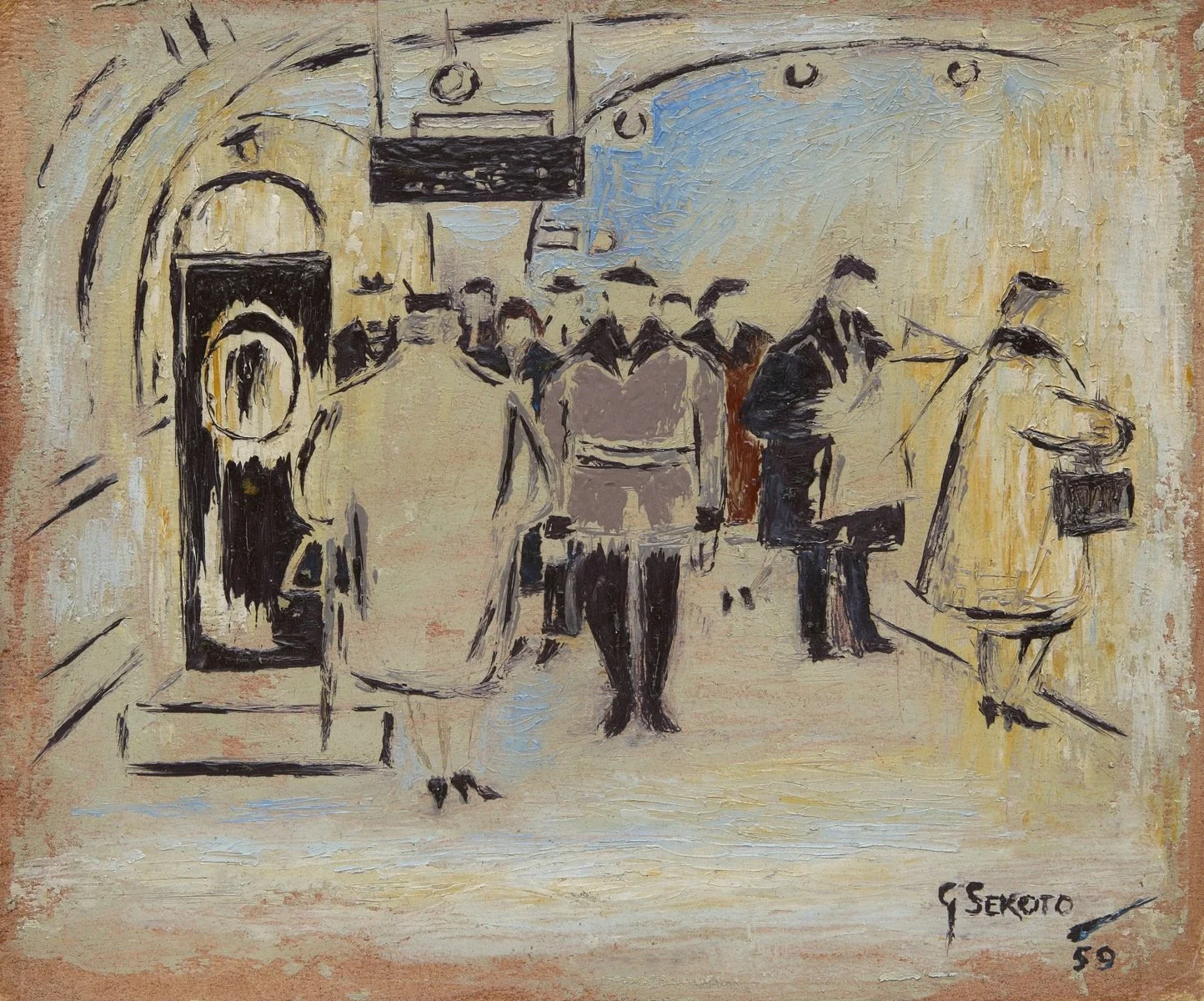
Gerard Sekoto - Paris Métro, 1959
22 × 26.5 cm
Provenance
Max Eden (1923–2014), acquired directly from the artist
By descent to his son, John Eden
A gift from the above to his then fiancée in the 1980s
Private Collection, UK
Painted in 1959, twelve years after Gerard Sekoto left South Africa for Paris, Paris Métro belongs to the moment at which exile had become, for him, a kind of freedom. It was a pivotal year. That spring Sekoto travelled to Rome for the Second Congress of Negro Writers and Artists, organised by Alioune Diop and Présence Africaine, for which he designed the official poster and won a prize, three years after Picasso had designed the poster for the first congress in Paris, to which Sekoto had sent a written account of his life as an artist in South Africa. In Rome he delivered his paper Responsibility and Solidarity in African Culture, taking its title from the theme of the congress itself. Paris Métro gives that vision of solidarity its most everyday form: a crowd of strangers waiting for a train.
The scene is a station platform beneath the vaulted, tiled ceiling of the Métro. A black station sign hangs from its wires, round lamps follow the curve of the vault, and at the left the dark front of a train, with its round window, has drawn in. On the platform the passengers wait in their winter coats and hats. A figure in grey stands square to us at the centre, a woman in a pale coat walks past at the right with her handbag on her arm, and another pale figure moves away at the left, her feet just touching the foot of the picture. None of them has a face. Sekoto brushes in each head as a single dark mark, and nothing distinguishes one passenger from another. The palette is pale and airy – cream, ochre, grey, and a sudden patch of sky blue, with one note of red-brown in the crowd. These are the “half-tones, blues and greys” that, in the words of his friend the writer Eve Dessarre, Sekoto had wrested from Paris.1 The paint is laid on thickly, the black drawing scored into it, while the bare card shows at the edges like a frame.
The faceless crowd is the heart of the picture, and its meaning is sharpened by everything Sekoto had painted before. In South Africa, trains and stations had been among his greatest subjects. Third Class Carriage (c. 1939–40), Three Men at a Railway Station (1940), In the Orlando Train (c. 1940–41), and Cyclists in Sophiatown (c. 1940–42) record, face by face, the daily journeys of Black workers through a divided country. There, every journey was policed. In the account he sent to the Paris congress, published by Présence Africaine in 1957, Sekoto described watching men marched through Johannesburg in chains for failing to produce their identification papers, “and behind goes a white man with pride! In a black helmet, sparkling buttons and a gun by his side!”2 He remembered the early-morning raids that caught labourers on their way to work, the long lines of men waiting to have their passes checked, and his own knees shaking whenever a policeman beckoned him across the road to inspect his papers. In those pictures, to travel was to be watched, counted, and controlled.
Paris transformed the motif. “In this city of Paris, everybody has the right to make himself at home, without being ordered about or told what to do,” Sekoto wrote in his autobiography. “I was struck by the seeming indifference of people to one another in the streets, on buses and in the Metro. Another surprising thing was to see youngsters of different races in cafés, just chatting and drinking together without any trouble whatsoever.”3 In Paris Métro that indifference becomes something close to grace. The passengers stand side by side, unremarked and unremarkable, and nothing in the painting marks any of them by race. No one in this crowd will be asked for his papers. Yet Sekoto did not paint the Métro as the opposite of home. Dessarre noticed that the idlers in the cafés and the travellers on the Métro platforms gave him “the fleeting moments when their gazes become sincere and resemble those of the starving Black peasants of Basutoland, and of the ragged of District Six”.4 Below the streets of Paris he found the same humanity he had painted in Johannesburg and Cape Town; the difference was that no one stood over it.
The same conviction ran through everything Sekoto wrote. In his 1957 account he insisted that “Art does not accept the colour line”, calling creative art “an interior human language”, and he closed with a short verse: “This colour line is just a lie / And could be a crime / When so imposed / on / Human Mind.”5 By the time of the Rome congress his tone had moved closer to Négritude, yet the image he chose to describe African art could almost be a caption for Paris Métro. In African masks and sculpture, he told the congress, an eye, a nose, an ear, a hand or a foot is “self-sufficient and yet… harmoniously part of a whole”; in an African community “everyone keeps his own personality”, and it is “the freedom to be what we feel that unites us”. Jazz musicians, he added, “never play better than when they freely follow their inspiration”.6 Sekoto knew this at first hand, having earned his living for years at the piano in the clubs of Saint-Germain-des-Prés. Paris Métro translates those ideals into the quiet gestures of daily life: a crowd of individuals, each self-contained, held together in a single rhythm.
The painting was given by Sekoto to the British painter Max Eden. The two had become friends in the early 1950s, when Eden was studying at the École des Beaux-Arts in Paris and both moved in the artistic world of the Left Bank. Parisian subjects are comparatively rare in Sekoto’s work. Barbara Lindop, his first biographer, observed that for most of his forty years in exile “the everyday lives of the French remain alien to him and Sekoto prefers to recreate an African memory”.7 The Métro was an exception, and one he returned to. A painting titled Metro, from the collection of the critic Dennis Duerden, was one of three works by Sekoto in the exhibition Contemporary African Art at the Camden Arts Centre in London in 1969. A preparatory pencil sketch for the present composition is in a private collection in Johannesburg, and a large canvas, The Paris Métro (1960), was sold at Bonhams on 1 October 2014.
In 1966, at the invitation of Léopold Sédar Senghor, Sekoto returned to African soil for the first time in almost twenty years, for the First World Festival of Negro Arts in Dakar; during that stay his South African passport expired and was not renewed, and his exile became permanent. The decades that followed were often hard. In the early 1980s his friend Abdou Berrada found him selling Métro tickets outside the Gare du Nord to make ends meet,8 a bitter echo of the subject he had once painted with such hope. Recognition came late. In 1989 the Johannesburg Art Gallery – the municipal gallery that had once refused even to let him clean its floors, before buying one of his paintings9 – mounted the retrospective Gerard Sekoto: Unsevered Ties, and he died in Paris in 1993. His place in the history of modernism is now secure. In 2024 his Self-Portrait of 1947 was shown in the Nucleo Storico of Stranieri Ovunque – Foreigners Everywhere at the 60th Venice Biennale, and the same work was chosen as the lead image of Paris noir at the Centre Pompidou in 2025.
Painted at the height of his Parisian years, in the year of Rome, Paris Métro holds Sekoto’s two worlds in a single, quiet scene: the trains of his South African youth, and the city that had let him travel through it as an equal.
1 Eve Dessarre, “La passion du monde”, Africa: Rivista trimestrale di studi e documentazione dell’Istituto italiano per l’Africa e l’Oriente 17, no. 1 (January–February 1962), pp. 19–23, at p. 23; translated from the French.
2 Gérard Sekoto, “A South African Artist”, Présence Africaine, n.s., nos. 14–15, Contributions au Ier Congrès des Écrivains et Artistes Noirs (June–September 1957), pp. 281–89, at pp. 283–86.
3 Gerard Sekoto, “Autobiography”, Présence Africaine, no. 69 (1st quarter 1969), pp. 188–94.
4 Dessarre, “La passion du monde”, p. 23; translated from the French.
5 Sekoto, “A South African Artist”, pp. 281–82, 289.
6 Gerard Sekoto, “Responsibility and Solidarity in African Culture”, Présence Africaine, nos. 27–28, Deuxième Congrès des écrivains et artistes noirs (Rome, 26 mars–1er avril 1959) (August–November 1959), pp. 263–67; translated from the French.
7 Barbara Lindop, “Gérard Sekoto: A Perspective on his Art”, Staffrider 7, no. 1 (1988), p. 11.
8 N. Chabani Manganyi, Gerard Sekoto: “I am an African” (Johannesburg: Wits University Press, 2004), p. 148.
9 Sekoto, “A South African Artist”, pp. 283, 285.