 Image 1 of 1
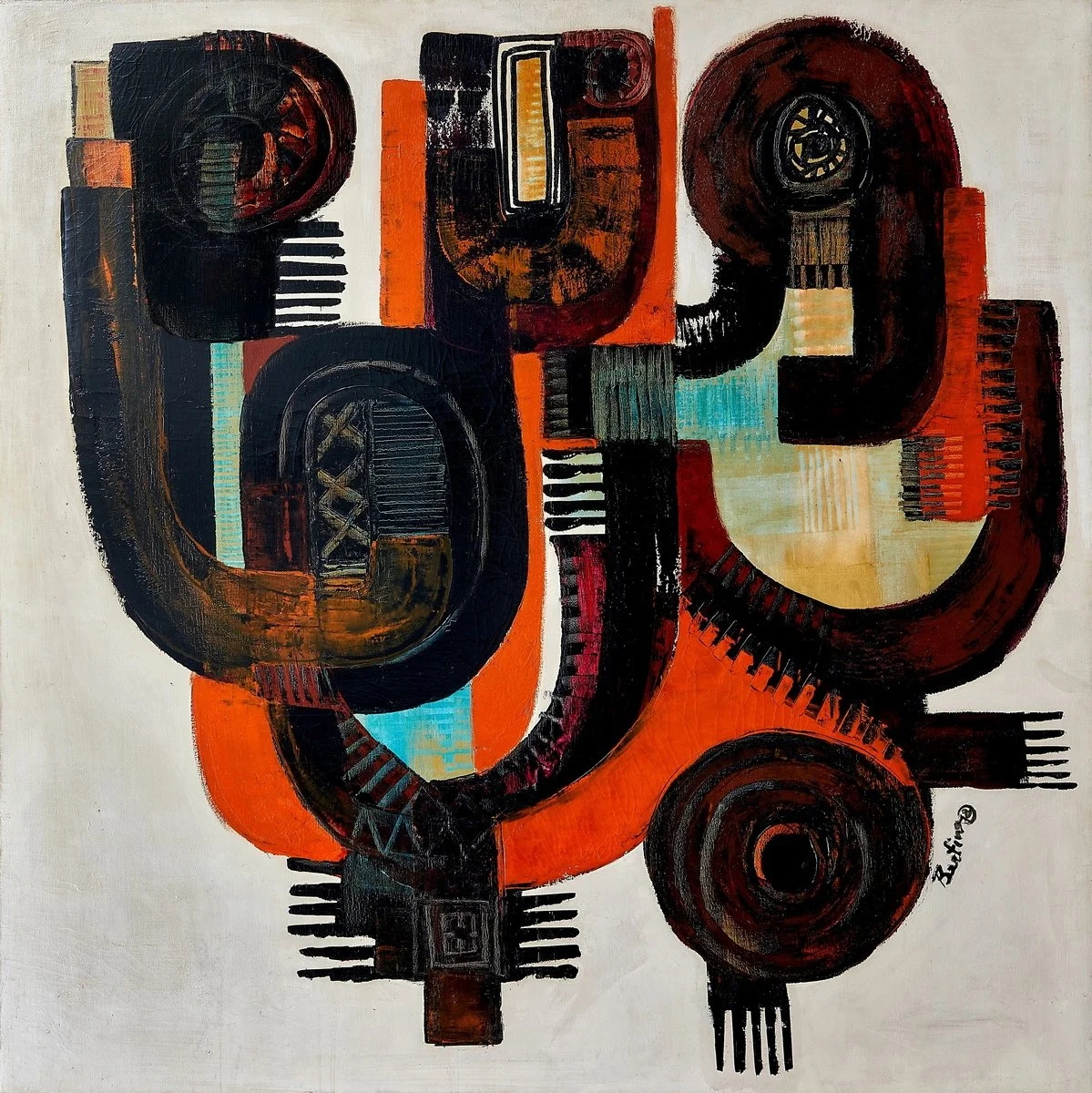
Bertina Lopes - Totem, 1978
140 × 140 cm
Provenance
Private Collection, Italy
A commanding testament to anti-colonial resistance and cross-cultural dialogue, Totem belongs to the celebrated series of that name that Bertina Lopes pursued from 1968 to 1981, the cycle in which she most fully reclaimed the art of her Mozambican homeland from her exile in Rome. Painted in 1978, three years after Mozambique won its independence from Portugal, and as the young nation was drawn into a civil war that would last until 1992, it rises from the canvas like a monument: a cluster of masked heads lifted on a single stem, held together by the force of one sweeping structure. Sister works from the series are held by the Baltimore Museum of Art, the Harvard Art Museums, and the Jordan Schnitzer Museum of Art.
Bertina Lopes was born in Lourenço Marques, now Maputo, on 11 July 1924, to a Mozambican mother and a Portuguese father. Her family moved to Lisbon while she was still a student, and it was there that she trained as an artist. She studied Cézanne and Matisse, began a lifelong admiration for Picasso, and moved in anti-fascist circles opposed to Salazar’s Estado Novo, which soon drew the attention of the secret police. Returning to Mozambique in 1953 to teach at the Escola Técnica General Machado, she left behind almost everything she had painted under Portuguese influence and set out to paint on her own terms. Prizes followed in Maputo and, in 1958, at Beira, and her art took on an openly political character. Her friendships with the anti-colonial poets José Craveirinha and Noémia de Sousa made her position untenable, and in 1961 political pressure forced her back to Lisbon.
In 1963, with the support of the Calouste Gulbenkian Foundation, she settled in Rome, where she would live and work for the rest of her life. In 1965 she married the artist Franco Confaloni. The Rome she found had few non-European artists, and Lopes was very probably the only African among them. Yet she became a vital figure in the city, serving as cultural attaché to the Mozambican embassy and making her studio a meeting place for African diplomats, activists, and intellectuals. Exile was the very starting point of her engagement: from Rome, Lopes fixed her mind unwaveringly on the independence, freedom, and autonomy of the peoples of Africa.
Distance only strengthened her bond with home. In Rome she surrounded herself with Makonde carvings, and in the series that followed – Raiz antiga (Ancient Root), Acrobatics, and above all Totem – she brought Mozambican ritual, fable, and myth to life through masked and hybrid figures. Her dialogue with European modernism was correspondingly complex. Picasso and his contemporaries had turned to African sculpture to resolve problems of form; for Lopes, those same forms were her own inheritance, the visible sign of her roots and identity. In reclaiming them she reversed the direction of modernism’s gaze. Chika Okeke-Agulu has argued that modern African art came into being through “a few individuals to whom art as an autonomous practice became a medium for expressing their subjectivity and coming to terms with their sociopolitical circumstances”.1 Few lives illustrate the point as vividly as hers.
Her sources were specific. The Makonde of northern Mozambique, whose people played a decisive part in the liberation struggle, gave her the mapiko masks danced at initiation and other great communal occasions. They also gave her the ujamaa sculptures, the “trees of life” carved from a single trunk of blackwood, in which interlocking figures rise towards a single crowning figure, an image of unity and of the continuity of a people. As Lucia Carrera has shown, Lopes adopted their verticality and their interweaving of masses throughout her work of these years.2 In the Totem series she also drew on the Nyau masquerades and the tufo dances, traditions that the colonial authorities had scorned and sought to suppress. When the Portuguese moved against local customs, communities answered by strengthening their rituals and turning them into vehicles of critique, ridiculing the colonisers and recounting tales of oppression and forced labour. To invoke these forms in paint was therefore never merely decorative. It was itself a political act. Enrico Crispolti, writing in 1986, saw that Lopes neither retreated into an imagined archaeological past nor surrendered to Western models; in her totemic structures, he argued, African forms became symbolic entities charged with a magical force entirely their own.3
Against a pale, chalky ground, Totem builds a single, interlocking emblem. From a stem at the foot of the canvas, fringed like a carved staff, great horseshoe and tubular forms sweep upwards and outwards to carry three heads. At the upper left is a dark disc, its eye ringed with radiating marks. At the centre rises a tall, rectangular face pierced by a narrow slot, and at the upper right a broad head turns about a spiralling eye. A fourth form, a great concentric disc, swings out at the lower right, as resonant as the frame drum of the tufo. Within the loops, windows of turquoise and pale gold open onto a distant light; a lattice of crossed lines fills the left-hand oval; a band of crimson and magenta runs down the central stem. Along every edge, comb-like fringes project like fins, fingers, or the teeth of a carved instrument.
The paint is laid on with great physical energy. Dense blacks, umbers, and burnt siennas are worked thickly with the knife and brush, then incised, combed, and hatched, so that the surface takes on the cut and grain of carved wood. Against them, Lopes sets passages of blazing orange, the colour at once of the sun-baked Mozambican earth and of revolutionary fire. The Cubist lesson of her Lisbon years is evident in the way she arranges several viewpoints and volumes on a single plane, but it is entirely subordinated to her own gesture. The heads seem to sway, the loops to turn, and the whole structure to move with the rhythm of a dance. Like the ujamaa carvings it recalls, the painting binds many figures into one body, crowned by the heads of a community that will not be broken.
The Totem series spans the most decisive years of modern Mozambican history, from the height of the liberation war in the late 1960s, through independence in 1975, to the civil war that followed. Lopes’s work remained tied to events at home throughout. In 1975 she celebrated freedom in La mia radice antica Mozambico. Omaggio all’indipendenza del Mozambico (My Ancient Root Mozambique. Homage to the Independence of Mozambique); in the years of conflict that followed, her compositions grew more dynamic and more charged with symbol. Totem holds both moods together. It is a triumphant emblem of a sovereign people, and at the same time a guardian figure, raised in a time of renewed danger to watch over its inheritance. “In my paintings you can feel the pain, the red, the grey,” she said. “I never left Mozambique. I lived in Italy, but my heart was always there.”4
Despite the barriers she faced as an African woman artist in Italy, Lopes achieved wide recognition in her lifetime. The Calouste Gulbenkian Foundation in Lisbon showed fifty works from her years as its scholar in 1972, and in 1993 devoted to her Bertina Lopes. Expressão Artística entre Duas Civilizações, her first major Portuguese survey, with sixty-five paintings and ten bronzes. An exhibition at the National Museum of Modern Art in Baghdad followed in 1981, and major retrospectives in Rome at the Palazzo Venezia in 1986 and the Palazzo della Cancelleria in 2002. In 2011 her work was shown in the Italian Pavilion at the 54th Venice Biennale. Among many honours, she received the Grand Prix d’Honneur of the European Union of Art Critics in 1988 and the World Prize of the Rachel Carson Memorial Foundation in 1991. In 1993 President Mário Soares appointed her a Commander of the Order of Merit of Portugal, and in 2002 the President of the Italian Republic awarded her a silver medal. In Mozambique, President Joaquim Chissano called her “Mama B”, the embodiment of the nation’s collective spirit,5 and Malangatana, the foremost Mozambican painter of the next generation, remembered her as “the father and mother of Mozambican visual arts”.6
She died in Rome in 2012. Her standing has only grown since. In 2015 her work was shown in Mozambique’s inaugural national pavilion at the Venice Biennale; in 2024 she was included in Stranieri Ovunque – Foreigners Everywhere at the 60th Biennale; and in 2025 the 36th São Paulo Bienal presented twenty-one of her paintings. Totem shows Lopes at the full height of her powers, in the series that defines her achievement. Painted far from the country to which she devoted her life, it gathers the masks, carvings, and dances of Mozambique into a single, soaring emblem, and turns the language of European modernism to the service of an African people’s freedom.
1 Chika Okeke-Agulu, “Modern African Art”, in Okwui Enwezor (ed.), The Short Century: Independence and Liberation Movements in Africa, 1945–1994 (Munich: Prestel, 2001), pp. 29–36, at p. 29.
2 Lucia Carrera, “Bertina Lopes: il riferimento all’arte tradizionale mozambicana nelle opere tra gli anni Cinquanta e Settanta”, Critica d’Arte, nos. 21–22 (Florence: Le Lettere, 2024).
3 Enrico Crispolti, Lungo viaggio di Bertina Lopes (Rome: Tipolitografia ITER, 1986).
4 Quoted in Claudio Crescentini, Bertina Lopes: arte e antagonismo (Rome: Erreciemme, 2017); translated from the Italian.
5 Quoted in Paola Rolletta, “Bertina Lopes, la pittrice ribelle del Mozambico”, Savana, 27 January 2006.
6 Quoted in Carrera, “Bertina Lopes”.