 Image 1 of 1
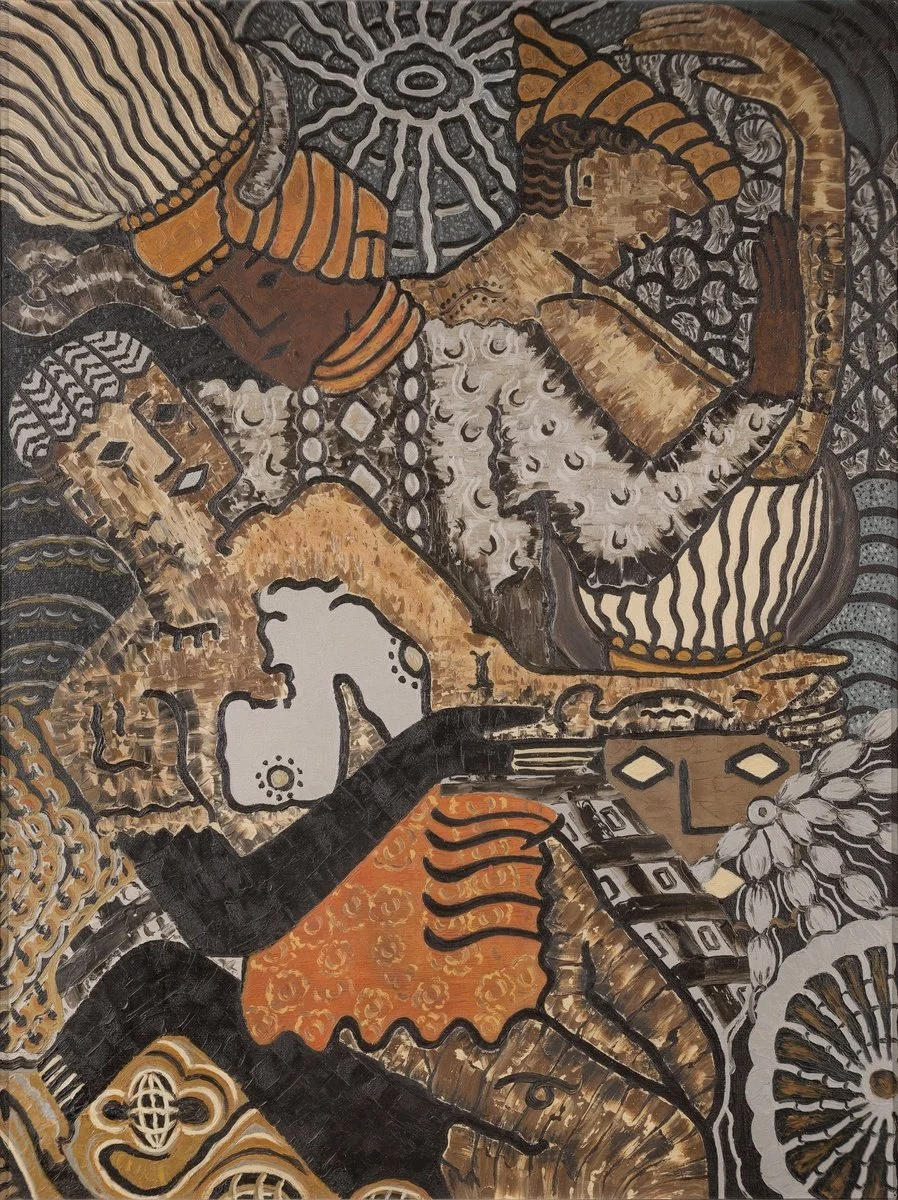
Uzo Egonu - Dancers, 1964
121 × 90.5 cm
Provenance
Dr John Akar, Sierra Leone Ambassador to the United States, acquired directly from the artist, circa late 1960s
Thence by descent
Sale, Bonhams, London, 22 May 2013
Sale, Bonhams, London, 12 October 2021
Exhibited
Paris, Centre Pompidou, Paris noir, 1950–2000, 19 March–30 June 2025, p. 174, illustrated
Literature
Olu Oguibe, Uzo Egonu: An African Artist in the West (London, 1995), p. 10, illustrated in a photograph of the artist in his studio
Painted in 1964, the year of Uzo Egonu’s first solo exhibition in London, Dancers belongs to the moment at which one of the most original painters of the African diaspora found his voice. Across a surface crowded to its very edges, heads, limbs, cloth, and ornament lock together in a single swaying rhythm, bound by a thick black line and worked in a rich impasto of ochre, burnt orange, silver-grey, and black. It is a painting in which the remembered Nigeria of the artist’s childhood and the modern painting he had mastered in Europe meet on equal terms.
Egonu was born in Onitsha, the historic royal city on the banks of the Niger in south-east Nigeria. His gifts were evident early, and in 1945 his father, a chieftain and local administrator, sent him to Britain at the age of thirteen to be educated as an artist. He trained at the Camberwell School of Arts and Crafts from 1949 to 1952, and then travelled widely on the Continent to study the old and modern masters. He was to remain in London for the rest of his life, returning to Nigeria only once, for FESTAC in 1977. That early separation from family and home marked him deeply, and gave his work its lasting preoccupation with the people, customs, and stories of his youth.
When he established his London studio in 1959, fourteen years after leaving home, Egonu began by painting remembered landscapes and scenes of Onitsha, as if to fix an image of the place he had lost. Memory proved an unsettling guide, and it led him towards a new pictorial language. Leaving behind the academic naturalism and perspective of his training, he set out in search of forms of his own. “I was like a curious archaeologist who, while digging the earth to uncover ancient relics, expecting something specific, chances on something else”, he recalled of these years (Hiltrud Streicher and Uzo Egonu, “Reflections of Uzo Egonu”, Third Text 3, 1989).
The early 1960s were the turning point. In 1963 he joined the Free Painters and Sculptors, and in 1964 he held his first solo exhibition, at the Woodstock Gallery. In the same years he immersed himself in the art of West Africa, above all the ancient Nok terracottas of Nigeria. In their compact, modelled forms, mask-like faces, and geometric clarity he found a path beyond European academicism, and a way of reducing the human body to interlocking planes and flattened, rhythmic outlines.
Dancers shows that language in full command. The figures are not set before us as on a stage; they fill the canvas from corner to corner, tilted on a strong diagonal as if caught in mid-turn. At the upper left a woman in an orange headwrap and a collar of beads inclines her dark profile; beside her a second dancer, head bound in striped cloth, raises both arms in an arc that follows the edge of the canvas. Ropes of white beads fall across a silvery bodice at the centre, and at the left a third face, pale and sharply cut, with diamond-shaped eyes, leans into the throng. Below them a wrapper of patterned orange swings across the picture, and from the lower right a mask stares out, its eyes two white lozenges. Between the figures the canvas is alive with radiating discs, fans, and bands of pattern that suggest the whirl of cloth. The eye is kept in constant movement, and it is the dance itself, more than any single dancer, that becomes the subject.
At the heart of the painting is what Egonu called his “poetry of lines”. By 1963 he had come to see line not as the mere boundary of a form but as “endless journeys... travelling without obstruction, and emerging again” (ibid.). Here a thick black contour, unbroken and unhurried, travels through the whole composition, pressing every form up against the surface and fusing figure and ground into a single shallow plane. The effect recalls the spatial experiments of Cubism, and it also invites comparison with uli, the linear wall and body painting traditionally practised by Igbo women, in which fluid, expressive line is likewise set within a shallow space.
The mask at the lower right is no incidental detail. In 1963–64 Egonu was absorbed in the study of African masks and musical instruments, and for him the mask stood both for a living African tradition and for the debt that European modernism owed to African art. To place it here, in a painting made in London by an African artist fluent in that modernism, was to reclaim it. Music runs through the picture too: pattern answers pattern, and texture answers texture, like instruments taking up a common beat.
Colour and surface are as carefully judged as line. Egonu restricts himself to the colours of the earth—burnt sienna, ochre, umber, and black—lifted by passages of silver-grey and cream that glint like beads and metal. They recall at once the fired clay of Nok and the natural pigments of the Igbo wall painters. The paint is laid on thickly, in short, loaded strokes that stand proud of the canvas, giving the surface the richness of woven cloth or beaten metal.
Egonu described the sources on which he drew—Igbo, Nok, and European—as footprints along his journey as an artist far from home. In Dancers those footprints converge. Painted at the outset of his mature career, in the year of his first solo exhibition, it is a jubilant and wholly assured statement by an artist who belongs equally to the history of Nigerian modernism and to that of modern British art.